
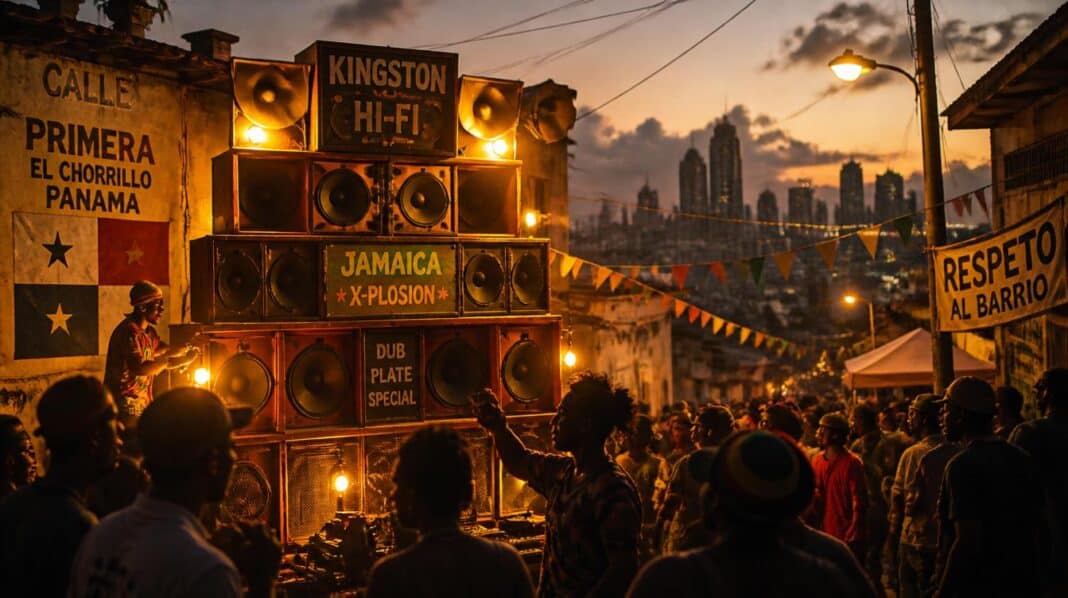
Reggaeton was built on one rhythm — the dembow — that traveled from Jamaican dancehall to Panama’s Spanish-language reggae to Puerto Rico’s 1990s underground, where it became the global genre we know today. That three-country lineage is the account most music scholars accept, though the exact point at which “reggae en español” becomes “reggaeton” is still debated. Strip away the auto-tune, the stadium shows, the Bad Bunny billions, and underneath every reggaeton song is the same heartbeat that started in Kingston.
This is the story of how a single beat crossed three countries and an ocean of prejudice to become the most-streamed sound on Earth.
The beat everyone copies
Listen to any reggaeton track — old-school Gasolina or a brand-new release — and you’ll feel it: boom-ch-boom-chick, a syncopated, looping drum pattern that never lets up. That’s the dembow. It’s the genre’s DNA. Producers have layered a thousand variations on top, but the skeleton almost never changes.
And the dembow wasn’t born in Puerto Rico, where most people assume reggaeton comes from. Musicologists trace it to Jamaica: Berklee College of Music places the rhythm’s roots in late-1980s Jamaican dancehall, years before it reached San Juan.
Jamaica: where it started
In 1990, Jamaican dancehall artist Shabba Ranks released a song called “Dem Bow.” Its riddim — built by Jamaican producers Steely & Clevie, on a track produced by Bobby “Digital” Dixon — had a propulsive, unmistakable drum pattern. The song’s lyrics were aggressive and, by today’s standards, deeply homophobic; “dem bow” was slang for submission. The politics of the lyric faded; the beat became immortal. The riddim’s own genealogy is tangled: as Red Bull Music Academy’s loop history of the dembow documents, the pattern most people call “the dembow” was assembled from several Jamaican riddims of the period rather than lifted whole from one record.
Dancehall itself is the child of Jamaican reggae, which is the child of ska and mento, which carry the rhythms enslaved Africans brought to the Caribbean centuries earlier. So the dembow isn’t just Jamaican — it’s the latest link in a chain that runs back to West Africa — the same chain that produced hip-hop itself in the Bronx. Keep that in mind; it matters at the end.
Panama: reggae en español
The next stop is the one history usually skips. In the late 1980s, Panama — home to a large Afro-Caribbean community descended from West Indian laborers who built the Panama Canal — started translating and toasting Jamaican dancehall into Spanish. They called it reggae en español.
Artists like El General (Edgardo Franco), Nando Boom, and Renato took Jamaican riddims, including the Dem Bow, and rapped over them in Spanish. El General’s late-’80s and early-’90s hits were, many historians of the genre argue, a direct precursor to reggaeton — before the word existed. Northeastern University’s research on the origins of reggaeton in Panama traces the sound to the diablos rojos buses that blasted it. Panama is the bridge that carried the Jamaican beat into the Spanish-speaking world — and Panamanian artists have long argued theirs is the most consistently overlooked contribution.
Puerto Rico: the underground
The beat landed in Puerto Rico in the early 1990s and exploded underground. In the housing projects (caseríos) of San Juan, DJs like DJ Playero and DJ Negro built mixtapes that fused the dembow with hip-hop, Spanish rap, and dancehall. They sold them hand-to-hand on cassette. The scene was literally called “underground.”
This is where the future stars came up. A young Daddy Yankee rhymed on DJ Playero’s tapes — part of the same producer-led scene we profile in the godfathers of reggaeton. Ivy Queen became the genre’s defining woman — though, as we’ve covered in the gender gap among reggaeton and Latin trap producers, the booth stayed overwhelmingly male. The sound got harder, faster, and unmistakably Puerto Rican — and somewhere in the ’90s it got its name: reggaeton.
The crackdown
Reggaeton almost didn’t survive its own home. In the mid-1990s, Puerto Rican authorities treated the music as a criminal problem. In February 1995, the Puerto Rico Police Department’s Drugs and Vice Control Bureau raided six record stores in the San Juan area and confiscated hundreds of cassettes and CDs of underground music, claiming the recordings breached local obscenity laws. Scholar Raquel Z. Rivera, who documented the raids and the censorship campaign around them, records that the charges against the stores were later dismissed by the Superior Court of San Juan. The campaign targeted the genre’s explicit lyrics and its association with poor, Black and working-class youth. (The National Guard sweeps of public housing in this period were a separate operation, Mano Dura Contra el Crimen; the two are often conflated.)
It backfired. The crackdown gave reggaeton exactly the outlaw credibility that made it irresistible. You can’t ban a beat that’s already in everyone’s body.
Gasolina and the global takeover
By the early 2000s the underground had a sound polished enough for radio. In 2004, Daddy Yankee’s “Gasolina” detonated worldwide — a song that took the dembow mainstream from Tokyo to Berlin. Barrio Fino became a landmark album. The floodgates opened: Don Omar, Wisin & Yandel, Tego Calderón.
Two decades later, Bad Bunny is one of the most-streamed artists on the planet, and reggaeton is simply pop in much of the world — even as corridos tumbados have started overtaking it on the charts. The beat that Puerto Rican police tried to seize is now the default sound of global summer.
The African through-line
Here’s the part that ties it together. The dembow’s boom-ch-boom-chick is, at its core, a West African polyrhythm — carried by enslaved Africans to Jamaica, refined into dancehall, translated in Panama, and perfected in Puerto Rico. Reggaeton is a four-stop journey of the African diaspora, each country adding its accent without ever changing the heartbeat — the same current that runs through salsa’s birth in New York, Garifuna history in Central America, and the West African roots of mofongo.
That’s why reggaeton feels like it belongs to everyone who claims it. It does. It’s the sound of the whole Black Atlantic, looping on forever — a heritage Afro-Puerto Rican scholar Arturo Schomburg spent his life proving was worth archiving, and one reason the Afro-Latino story belongs in every telling of Latin music.
Frequently Asked Questions
Where did reggaeton originate?
Reggaeton’s beat — the dembow — originated in Jamaican dancehall (1990), was adapted into Spanish in Panama, and was developed into the genre called reggaeton in Puerto Rico’s underground scene in the 1990s.
What is the dembow?
The dembow is the signature drum pattern under nearly every reggaeton song. It comes from the riddim of Shabba Ranks’ 1990 Jamaican dancehall track “Dem Bow,” built by producers Steely & Clevie.
Is reggaeton from Puerto Rico or Panama?
Both, in different ways. Panama created Spanish-language reggae (“reggae en español”) in the late 1980s; Puerto Rico developed it into reggaeton in the 1990s and gave it its name and global stars.
Who invented reggaeton?
There’s no single inventor. Key figures include Jamaica’s Shabba Ranks (the beat), Panama’s El General (Spanish reggae), and Puerto Rico’s DJ Playero, Daddy Yankee, and Ivy Queen (the genre itself).
What’s the difference between reggaeton and dancehall?
Dancehall is the Jamaican genre reggaeton grew from. Reggaeton is its Spanish-language, Puerto Rico-born descendant — built on the dembow but fused with hip-hop and Latin influences and sung/rapped in Spanish.
Watch on Wehpa
For more on the beats and roots behind the music you love, head to Wehpa TV — free on Roku.
Puerto Rico was not the first Latin American state to treat music as a threat. Two decades earlier in Chile, the dictatorship went further: Víctor Jara was arrested the day after the coup and shot dead three days later.
Sources
- Raquel Z. Rivera, Wayne Marshall & Deborah Pacini Hernandez (eds.), Reggaeton: Refiguring American Music, Duke University Press, 2009.
- Berklee College of Music, “Dembow Explained: Tracing the Roots of a Global Phenomenon.”
- Northeastern University, “The Origins of Reggaeton in Panama,” Beyond the Panama Canal.
- Raquel Z. Rivera, “Policing Morality: Underground Rap in Puerto Rico.”
- Red Bull Music Academy Daily, “Dembow: A Loop History.”
Researched and written by Victor Ramirez. Edited and fact-checked by Mia Alejandra Umphrey. Drafting assisted by AI; all facts verified against the sources above before publication. See our editorial standards.
Correction, 26 July 2026. An earlier version said police and the National Guard raided record stores in Puerto Rico in 1995. That merged two separate operations. The 1995 record-store raids were carried out by the Drugs and Vice Control Bureau; the National Guard deployments belong to the separate Mano Dura Contra el Crimen policy. The article now distinguishes them. All corrections.

Part of our guide to Latin Music History.