
The short version: Nobody alive invented tamales — the dish is roughly 7,000 years old. Tamales were first made by the Indigenous peoples of Mesoamerica around 5,000 BC, long before the Maya or Aztec. The word comes from the Nahuatl tamalli, meaning wrapped. Every later version — Venezuelan hallacas, Nicaraguan nacatamales, Colombian tolimenses — descends from that one Mesoamerican original.
Show up at any Latino household between November and January and there’s a tamalada happening somewhere. The wrapping, the assembly line, the arguing over how much masa is too much masa. Every family thinks theirs is the real one. Every country thinks theirs is the original. So who actually invented the tamale?
The short answer: nobody alive can claim it. The tamale predates every modern Latin American country by several thousand years. The longer answer is the part Latinos love arguing about.
What the archaeology says
Researchers have traced tamale-like preparations back to roughly 5,000 BC in Mesoamerica — meaning before the Maya, before the Aztec, before any civilization whose name we still recognize. The Olmecs, the Toltecs, and the early peoples of what is now Mexico and Guatemala were already wrapping ground corn around fillings and steaming them in leaves. Mayan codices show tamales being prepared as ceremonial food, food for warriors, food for the gods.
The word itself is Nahuatl. Tamalli means “wrapped.” Spanish colonizers adopted the word, the dish, and the technique, then carried both across the empire — which is why every former Spanish colony from California to Argentina ended up with its own version.
So the answer to “who invented it” is: the Indigenous peoples of Mesoamerica, primarily the ancestors of today’s Mexicans and Guatemalans. Everyone else inherited the technique and made it their own. That part is where it gets interesting.
Mexico — the volume champion
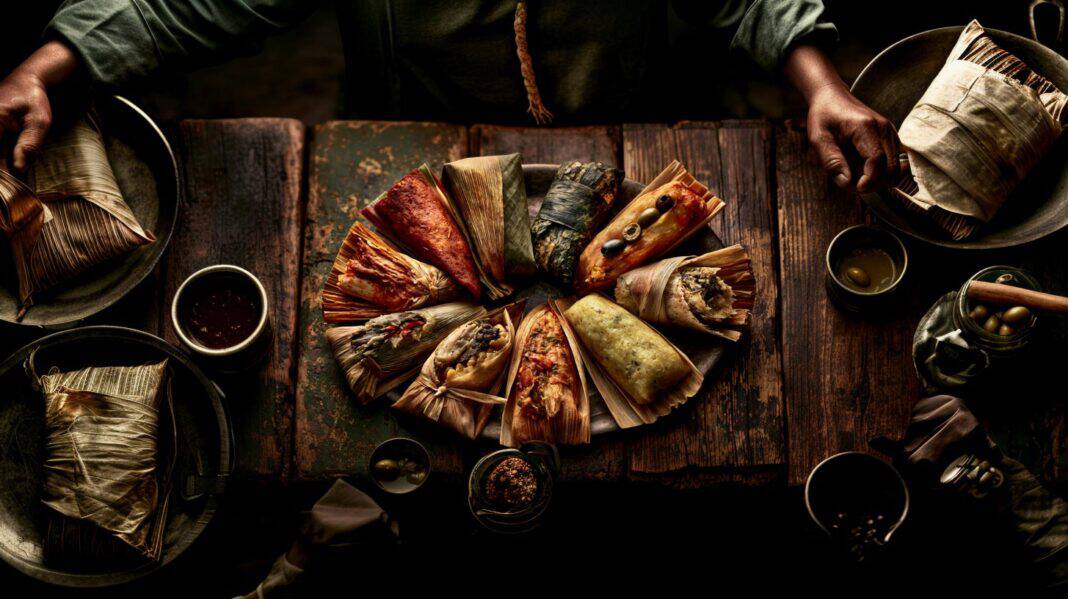
Mexican tamales are corn-husk wrapped, smaller than most, and come in dozens of regional variations. Rojo with red chile and pork. Verde with salsa verde and chicken. Mole in Oaxaca. Dulce with pineapple, raisins, and pink-dyed masa. Oaxaca itself wraps tamales in banana leaves — closer to the Guatemalan tradition than the Mexico City one, a reminder that the country contains multitudes.
Guatemala — the heavyweight class
Guatemalan tamales are banana-leaf wrapped, often the size of a small football, and dense with recado (a rich sauce of tomato, chile and spice). The paches are made with potato instead of corn masa. Chuchitos are smaller, corn-husk versions you eat as a snack. Guatemala will tell you — correctly — that their version is closest to what the Maya were actually eating.
Nicaragua — the Sunday all-day meal
The nacatamal is its own continent. Massive, banana-leaf wrapped, stuffed with pork, rice, potato, raisins, olives, and mint. You eat one and you don’t need lunch. Nicaragua treats nacatamales the way the U.S. treats Thanksgiving turkey — Sunday production, family event, leftovers for days.
Cuba and Puerto Rico — the Caribbean fork
Cuban tamales are typically corn-husk wrapped and lean closer to the Mexican format, with pork and a touch of sweetness. Puerto Rico’s pasteles are not tamales technically — they use green plantain and yautía instead of corn — but the technique is identical and the family is the same. They are a Caribbean adaptation of the Mesoamerican original, made with what the islands actually grew.
Colombia — the regional showdown
Every region of Colombia has its own tamal. The tolimense has rice, peas, carrot, chicken, pork, and a hard-boiled egg, all wrapped in plantain leaf. The santafereño is leaner. The valluno has chickpeas. Colombia treats the tamal as a regional identity card — tell us where your tamal is from and we know where your grandmother is from.
Venezuela — the Christmas hallaca
This is where the family tree gets beautiful. The hallaca is wrapped in plantain leaves and contains a stew of beef, pork, chicken, raisins, capers, olives, and sweet peppers. It only shows up at Christmas. The story Venezuelans tell is that hallacas were created by enslaved cooks in colonial households who took the leftovers from the Spanish family’s holiday meal and wrapped them in masa — a story of survival and creativity dressed up as a Christmas tradition.
Peru, Ecuador, Bolivia — the humita branch
Across the Andes, humitas are made from fresh, sweeter corn rather than dried masa. They’re often unfilled, sometimes sweet, sometimes savory with cheese. They’re not tamales in the strict sense, but they are the Andean cousin — proof that the technique traveled south long before any European arrived.
Brazil — the pamonha
Even Brazil has the cousin. Pamonha uses sweet corn, often coconut milk, and is wrapped in corn husks. The Portuguese brought enslaved Africans to a continent already eating wrapped-corn dishes, and the result is on every street corner of Goiânia today.
The verdict
Mesoamerica invented the tamale. Mexico and Guatemala carry the deepest unbroken tradition. Every country south and east took the technique and remade it with whatever the soil and the sea handed them. There is no winner. There is only the tamalada — and the kitchen full of women your grandmother trained, arguing about whether the masa needs more lard.
Watch on Wehpa
For more food origin stories that started in one civilization and ended up on every corner of the world, head to Wehpa TV — free on Roku.
Frequently asked questions
Who invented tamales?
The Indigenous peoples of Mesoamerica invented tamales — the ancestors of today Mexicans and Guatemalans — around 5,000 BC, long before the Maya or Aztec. No single modern country can claim them.
How old are tamales?
Tamale-like preparations trace back roughly 7,000 years, to about 5,000 BC in Mesoamerica. Mayan codices already show tamales served as ceremonial food.
What does the word tamale mean?
It comes from the Nahuatl word tamalli, meaning wrapped. The Spanish singular is tamal; the plural is tamales.
Which country has the original tamale, Mexico or Guatemala?
Both carry the deepest tradition, but Guatemala banana-leaf tamales are arguably closest to what the Maya ate. Neither invented it — both inherited it from the same ancestors, like other foods of the Americas.
Are Puerto Rican pasteles tamales?
Not technically — pasteles use green plantain and yautia instead of corn masa, but the wrapping-and-steaming technique is the same, making them a Caribbean cousin.
The tamale is not the only maize dish two countries argue over. Venezuela and Colombia both claim the arepa — and the honest answer is the same shape.
Sources
- “Iconic Cuisine: Tamales of the Maya”, HistoricalMX.
- “Mexican Tamales”, Museum of Food and Culture.
Researched and written by Victor Ramirez. Edited and fact-checked by Mia Alejandra Umphrey. Drafting assisted by AI; all facts verified against the sources above before publication. See our editorial standards.

Part of our guide to Latin Food Origins.