


The short version: In the regional mexican vs reggaeton story, regional Mexican music pulled ahead on Billboard in 2023 because corridos tumbados, led by Peso Pluma, fused traditional guitar-and-brass ballads with trap energy. Regional Mexican streams grew 60 percent in the U.S. that year, and at one point 13 of 17 Spanish-language Hot 100 tracks were regional Mexican.
For most of the 2010s, reggaeton was the undisputed engine of Latin music’s global rise. Then a homegrown sound from northern Mexico and the U.S. Southwest changed the math. This is a celebration of that shift, told through the numbers.
Regional Mexican vs reggaeton: what the Billboard data actually shows
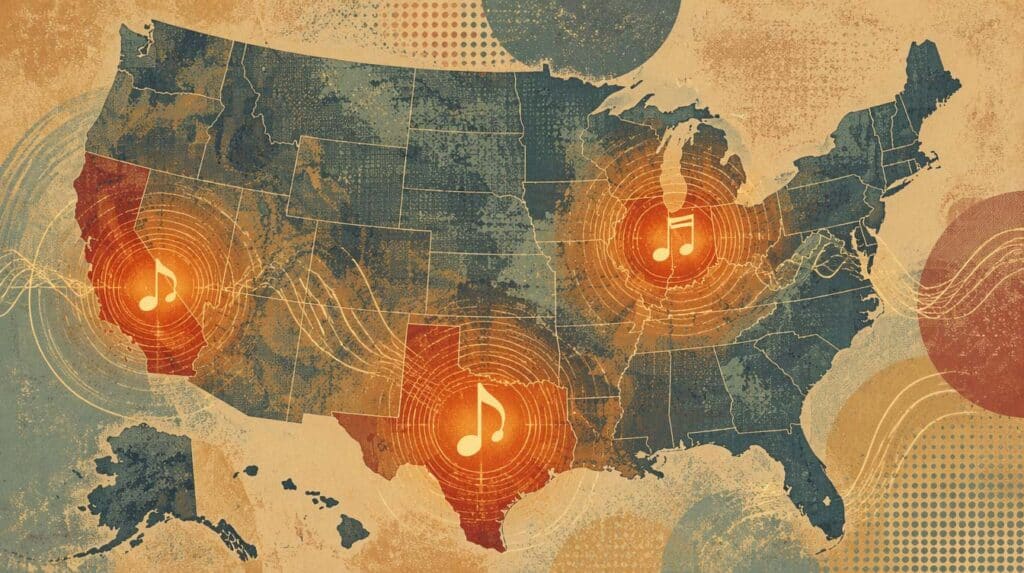
The turning point arrived in 2023. According to Billboard, at one point that year 13 of the 17 Spanish-language tracks on the all-genre Hot 100 were regional Mexican songs. That is not a niche bubbling up; that is a genre taking over the most competitive chart in American music.
- Regional Mexican music grew roughly 60 percent in the U.S. in 2023.
- The genre accounted for about 21.9 billion on-demand audio streams.
- Four of the six Latin artists to top 1 billion U.S. streams that year were Mexican: Peso Pluma, Eslabon Armado, Junior H and Fuerza Regida.
- Peso Pluma’s album “Genesis” debuted at No. 3 on the all-genre album chart, the highest position ever for a regional Mexican album.
The corridos tumbados sound: trap attitude, acoustic roots
What makes corridos tumbados land so hard is that it sounds like nothing else on the charts. Where reggaeton is built on the dembow drum pattern, Auto-Tune and synths, today’s Mexican music is earthy, guitar- and brass-based, and often recorded without drum machines. Artists like Natanael Cano, Peso Pluma, Junior H and Fuerza Regida kept the storytelling spine of the corrido and wrapped it in trap swagger and streetwear style.
The corrido itself is no trend. Writing and performing corridos has been traced back to the early 1800s, and through Mexico’s 1810 War of Independence and the 1910 Revolution they served as the community’s news, history and memory in song, as the U.S. National Park Service documents. Corridos tumbados are the newest chapter of a 200-year-old tradition.
Why regional Mexican vs reggaeton tilted toward Mexico
Several forces converged at once:
- Demographics and pride. Mexican Americans are the largest Latino group in the U.S., and a generation raised on both sides of the border finally heard its own backyard sound dominate mainstream playlists.
- Streaming and short video. Peso Pluma became 2023’s most-streamed artist on YouTube, and TikTok turned regional cuts into global hits overnight.
- Newness. After a decade of reggaeton ruling Latin radio, corridos tumbados offered listeners a fresh texture without abandoning Spanish-language identity.
Importantly, this is not a feud. Reggaeton’s long climb built the global Latin audience that regional Mexican now reaches. If you want the backstory on that genre, see our history of reggaeton and its origins. The two scenes increasingly collaborate rather than compete.
Built on giants: the long road to the Hot 100
Regional Mexican did not appear from nowhere. Mariachi, banda, norteno and Tejano laid generations of groundwork, and crossover pioneers proved Spanish-language music could move mainstream culture. The blueprint owes a debt to artists like Selena Quintanilla, whose legacy showed a U.S. audience that Mexican American music belonged at the center, not the margins. Today’s stars are sprinting down a track that earlier generations cleared.
The cultural pride runs deep enough to touch everything from the music to the merch to the table. It is the same instinct that has Latinos insisting on the real thing in small everyday choices, like our piece on Mexican Coke vs American Coke captures. Roots show up in the details.
Where the rivalry goes from here
The smart read is not “one beat the other” but “the menu got bigger.” Reggaeton stars and corridos artists now trade features, and regional Mexican is exporting to Chile, Spain and beyond. The Smithsonian Folkways collections that preserve the corrido as historical record are a reminder that this sound carries memory as well as momentum. Whatever tops the chart next quarter, both genres are bigger because of each other.
Watch: the rise of regional Mexican music explained
Frequently asked questions
Did regional Mexican music actually overtake reggaeton on Billboard?
On the all-genre Hot 100 in 2023, yes, by share of Spanish-language placements. At one point 13 of the 17 Spanish-language songs on the chart were regional Mexican. Reggaeton remained massive globally, but Mexican music led that U.S. moment.
What are corridos tumbados?
Corridos tumbados are a modern subgenre that blends the traditional Mexican corrido ballad with the attitude, slang and production feel of Latin trap. Natanael Cano helped popularize the label, and Peso Pluma carried it to global charts.
Who is Peso Pluma and why does he matter?
Peso Pluma is a Mexican singer who became 2023’s most-streamed artist on YouTube. His album “Genesis” debuted at No. 3 on the all-genre Billboard album chart, the highest ever for a regional Mexican record.
Is regional Mexican music replacing reggaeton?
No. Both genres are growing, and artists from each scene increasingly collaborate. Reggaeton built the global Latin audience that regional Mexican now reaches, so the relationship is more crossover than competition.
How old is the corrido tradition?
Very old. Corridos have been sung on both sides of the border since the early 1800s and served as news and historical record during Mexico’s wars of independence and revolution. Corridos tumbados are its newest evolution.
Watch on Wehpa
Stream Latino music documentaries and culture shows free on Wehpa TV, now on Roku.
Sources
- “The Year in Charts: Billboard’s Top 10 Latin Artists of 2024”, Billboard.
- “The Year in Charts: Billboard’s Top 10 Hot Latin Songs of 2024”, Billboard.
Researched and written by Victor Ramirez. Edited and fact-checked by Mia Alejandra Umphrey. Drafting assisted by AI; all facts verified against the sources above before publication. See our editorial standards.

Part of our guide to Latin Music History.