

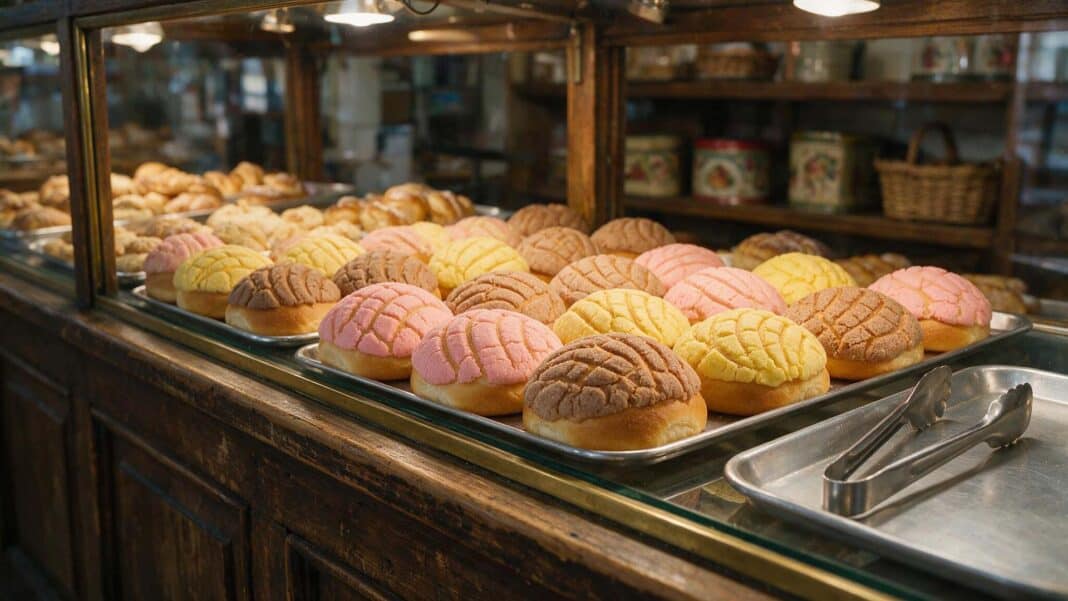
The short version: The concha — the soft, round sweet bread with a crackly seashell-patterned sugar topping — is the most beloved of Mexico’s pan dulce, and the account most food historians favour is that it is a Mexican remix of French baking that arrived in the 1800s — though no single documented moment of invention survives. The bread that feels most like a Mexican abuela‘s kitchen got its DNA from French bakers, then became something entirely its own.
Dunk one in café con leche and you’re tasting two empires and a couple centuries of history.
Bread came late to the Americas
Wheat isn’t native to the Americas — the Spanish brought it in the 1500s, and for a long time bread was a colonial, upper-class food layered on top of the Indigenous corn tradition. Mexico had bread, but it didn’t yet have its glorious universe of pan dulce.
The French connection
The concha has no birth certificate. What food historians can trace is a shift in the 19th century, when French baking techniques flowed into Mexico — accelerated by French presence during the era of the French Intervention (1860s) and the brief rule of Emperor Maximilian. French bakers and their methods — enriched, buttery doughs in the brioche family — fused with Mexican tastes and with the Spanish colonial baking that already existed. Some accounts push the concha’s roots back further, to that earlier colonial period; what nobody disputes is that the finished thing is Mexican.
Out of that fusion came pan dulce: hundreds of regional sweet breads with playful names — conchas (shells), orejas (ears), cuernos (horns), besos (kisses), novias, puerquitos. The concha is the crown of that family, and it’s essentially a Mexican sweet roll wearing a sugar-paste shell.
What makes a concha a concha
The magic is the two-part build: a soft, lightly sweet bread base, topped with a paste of sugar, flour, and fat that’s pressed and scored into the signature seashell (concha) pattern before baking. As it bakes, the topping crackles into that distinctive crust. Classic flavors are vanilla (white/yellow) and chocolate (brown), though pink and other colors are common.
The name is literal: concha means “seashell.” Mexico took a French enriched dough and gave it a shell — and a Spanish name for the shape.
The panadería ritual
The concha isn’t just a pastry; it built an institution: the panadería. The ritual of walking in, grabbing a metal tray and tongs, and stacking your own pan dulce is a core memory for millions. Conchas anchor the morning and evening bread hour — merienda — eaten with coffee, hot chocolate, or atole. It’s everyday, affordable, and woven into family rhythm in a way fancier pastries never are.
The concha goes global
Lately the concha has crossed over hard. In the U.S., Mexican-American bakeries have turned it into concha ice-cream sandwiches, conchas stuffed with pan con chicharrón, latte-flavored conchas, even concha-inspired streetwear and emojis-worthy internet fame. The humble shell became a symbol of Mexican-American pride.
But ask anyone who grew up with them and the trend versions miss the point. The real concha is the one slightly stale by evening, dunked in coffee at the kitchen table — French technique, Mexican soul, eaten the way it’s always been eaten.
The rest of the pan dulce family
| Name | Means | What it is |
|---|---|---|
| Concha | Seashell | Sweet roll under a scored sugar-paste crust |
| Oreja | Ear | Flat, crisp palmier of laminated pastry |
| Cuerno | Horn | Crescent-shaped roll, close to a croissant |
| Beso | Kiss | Two domes joined with jam, rolled in sugar |
| Puerquito | Little pig | Pig-shaped piloncillo gingerbread |
| Novia | Bride | Sweet roll with a sugar or meringue topping |
Frequently Asked Questions
What is a concha?
A concha is a Mexican sweet bread (pan dulce) made of a soft, lightly sweet roll topped with a crackly sugar-paste crust scored in a seashell pattern. “Concha” means “seashell” in Spanish.
Are conchas French or Mexican?
Both, in a sense. Conchas are thoroughly Mexican, but most food historians trace the enriched sweet-dough techniques behind pan dulce to French baking that entered Mexico in the 1800s, building on the Spanish colonial bread tradition that arrived centuries earlier. The exact origin of the concha itself is not documented.
What flavors do conchas come in?
The classic flavors are vanilla (white or yellow topping) and chocolate (brown topping), with pink and other colors also common. The bread base tastes about the same; the topping defines the flavor.
What does concha mean?
It means “seashell” in Spanish — a reference to the scored, shell-like pattern of the sugar crust on top of the bread.
What is pan dulce?
Pan dulce (“sweet bread”) is the broad family of Mexican sweet breads — including conchas, orejas, cuernos, and many more — typically eaten with coffee or hot chocolate during merienda.
Sources
A note on this one. The concha has no documented moment of invention, and no Tier 1 or Tier 2 source — museum, university, archive or established journalism — covers its specific origin. Only bakery marketing and recipe sites do, and citing those would borrow authority they do not have.
This page therefore says what food historians favour rather than what happened: that the concha is a Mexican remix of French enriched-dough baking that entered Mexico in the nineteenth century, on top of Spanish colonial bread. The French Intervention of the 1860s and the reign of Maximilian are documented history; the causal link to this particular bread is inference, and the page marks it as such.
What is not in dispute: wheat is not native to the Americas, concha means seashell, and the finished thing is Mexican.
Researched and written by Victor Ramirez. Edited and fact-checked by Mia Alejandra Umphrey. Drafting assisted by AI; no Tier 1 or 2 source exists for the concha’s origin, so the account here is attributed to the prevailing view among food historians rather than asserted — see the note above. See our editorial standards.

Part of our guide to Latin Food Origins.