
Tacos al pastor are a direct descendant of Lebanese shawarma: Lebanese immigrants brought spit-roasted meat and the vertical rotisserie to Mexico in the early 1900s, and Mexican cooks made it their own — swapping lamb for chile-marinated pork. The most Mexican taco on the menu started as a Middle Eastern import.
If you’ve ever watched a taquero shave glistening pork off a spinning vertical spit, you’ve watched a technique that didn’t come from Mexico at all. It came from Lebanon — and the journey from one to the other is one of the great untold immigration stories of the Americas.
The “turcos” who weren’t Turkish
Between the 1890s and 1920s, as the Ottoman Empire collapsed, tens of thousands of Lebanese, Syrian, and Palestinian migrants left the Levant and scattered across Latin America. Because they carried Ottoman passports, officials lumped them under one wrong label: turcos — “Turks” — even though most were Arabic-speaking Christians from what is now Lebanon.
Many settled in the Mexican state of Puebla. And they brought their food with them — including shawarma: seasoned lamb stacked on a vertical spit, slow-roasted, and shaved into thin slices to be wrapped in flatbread.
Puebla and the taco árabe: the missing link
In the 1930s, Puebla’s Lebanese-Mexican community created the dish that bridges the two worlds: the taco árabe (“Arab taco”). It was almost pure shawarma — spit-roasted lamb, shaved to order — but served on pan árabe, a pita-like flatbread, with a chipotle-based salsa instead of tahini or garlic sauce.
The taco árabe is the fossil record. It’s the exact midpoint between a Beirut street stand and a Mexico City trompo.
From lamb to achiote pork
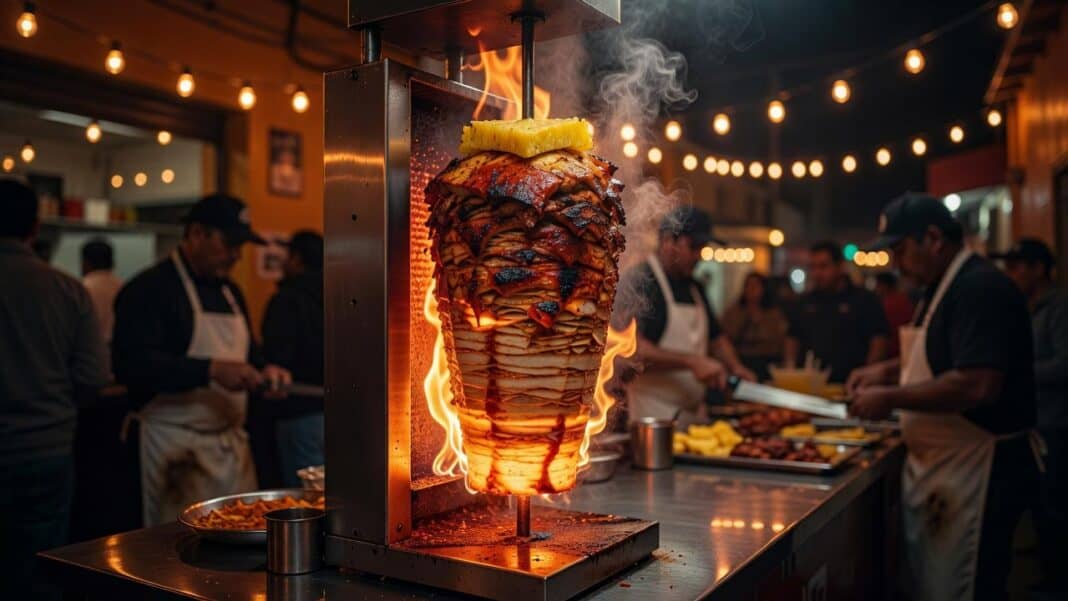
Mexico took the technique and rebuilt the flavor from the ground up. Lamb gave way to pork — cheaper, more abundant, and central to Mexican cooking. The meat got marinated in a deep-red adobo of achiote, dried chiles, and spices, which is where al pastor gets its signature color and name: al pastor means “shepherd style,” a nod to the shepherds’ spit-roasted lamb it descended from.
The pita became the corn tortilla. The salsa went full Mexican. And the dish stopped being foreign.
The pineapple question
The most debated topping — that slice of pineapple crowning the trompo — is the part most likely invented in Mexico, sometime mid-century, though no one can prove who did it first. What’s clear is that it’s the one ingredient with no Lebanese ancestor at all. It’s Mexico signing its name on someone else’s invention and making it unmistakably its own.
The trompo is the evidence
You can argue about pineapple and marinades forever, but the trompo — the vertical spit itself — settles it. Stacking meat vertically and roasting it as it turns is not an Indigenous Mexican or Spanish technique. It’s Levantine, the same machine that makes shawarma in Beirut and döner in Istanbul. Every al pastor stand in Mexico is running Lebanese hardware.
That’s the beautiful thing about al pastor. It isn’t “less Mexican” for being Lebanese underneath — it’s more Mexican, because making something foreign completely your own is the most Mexican thing a dish can do.
Shawarma, taco árabe, al pastor
| Shawarma | Taco árabe | Taco al pastor | |
|---|---|---|---|
| Where | Levant | Puebla | Mexico City and outward |
| Meat | Lamb | Pork | Pork |
| Seasoning | Levantine spices | Lightly spiced | Achiote and dried chillies |
| Bread | Pita | Pan árabe, a pita-like flatbread | Corn tortilla |
| Served with | Garlic sauce, vegetables | Chipotle-based sauce | Onion, coriander, pineapple |
| Cooked on | Vertical spit | Vertical spit | Vertical spit — the trompo |
Frequently Asked Questions
Are tacos al pastor really Lebanese?
The technique is. Tacos al pastor descend from shawarma, brought to Mexico by Lebanese immigrants in the early 1900s. Mexican cooks adapted it — pork instead of lamb, achiote marinade, corn tortillas — but the vertical spit-roasting method is Levantine in origin.
What’s the difference between tacos al pastor and tacos árabes?
Tacos árabes are the older, more direct version from Puebla: spit-roasted meat on a pita-like pan árabe. Tacos al pastor are the Mexicanized evolution — marinated pork on corn tortillas with onion, cilantro, and pineapple.
Why is it called “al pastor”?
“Al pastor” means “shepherd style” in Spanish — a reference to the spit-roasted lamb of the shepherds who inspired the original Lebanese dish, even after Mexico switched the meat to pork.
What meat is in tacos al pastor?
Pork, marinated in a red adobo of achiote (annatto) and dried chiles, stacked on a vertical spit called a trompo and shaved off as it roasts.
Where were tacos al pastor invented?
In Mexico — most directly traced to the Lebanese-Mexican community of Puebla, where the intermediate taco árabe appeared in the 1930s before evolving into al pastor in Mexico City.
Mexico is not alone in this. Peru’s national dish went through the same transformation: Japanese immigrants reinvented ceviche, and the version everyone now calls classic is barely sixty years old.
Sources
- “Thank the Ottoman Empire for the taco al pastor”, The World (PRX).
- “Tacos Al Pastor: A Mexican Dish”, HistoricalMX.
Researched and written by Victor Ramirez. Edited and fact-checked by Mia Alejandra Umphrey. Drafting assisted by AI; all facts verified against the sources above before publication. See our editorial standards.

Part of our guide to Latin Food Origins.