
Neither — and both. The arepa predates Venezuela and Colombia by centuries. Indigenous peoples across what is now northern South America were grinding maize and cooking flat maize cakes long before either country existed, so no modern border can claim to have invented it.
What each country can claim is its own arepa tradition, and those are genuinely different.
The dish is older than the countries arguing about it
Arepas come out of the same maize world as elote and the other crops the Americas gave the world. Maize was domesticated in Mesoamerica and spread south; by the time Europeans arrived, peoples across the northern Andes and the Caribbean coast were cooking with it daily.
Two groups are usually named. In the Venezuelan Andes, the Timoto-Cuica. In the Colombian highlands and along the Caribbean coast, the Muisca and the Zenú. Both regions ground maize, both shaped it into rounds, both cooked it on a clay griddle. The territory they occupied is now split by a border drawn in the nineteenth century.
Where the word comes from
The most commonly cited etymology traces arepa to erepa, a Cumanagoto word for maize bread. The Cumanagoto were an Indigenous people of what is now north-eastern Venezuela. Sixteenth-century Spanish chroniclers recorded the dish among peoples they encountered, though — as with most colonial-era food records — the accounts are thin and the spellings inconsistent.
The etymology is widely repeated but should be held loosely: it points to the Venezuelan side, and it is not decisive proof of where the food began.
The two traditions really are different
The border argument would be less heated if the arepas were the same. They are not.
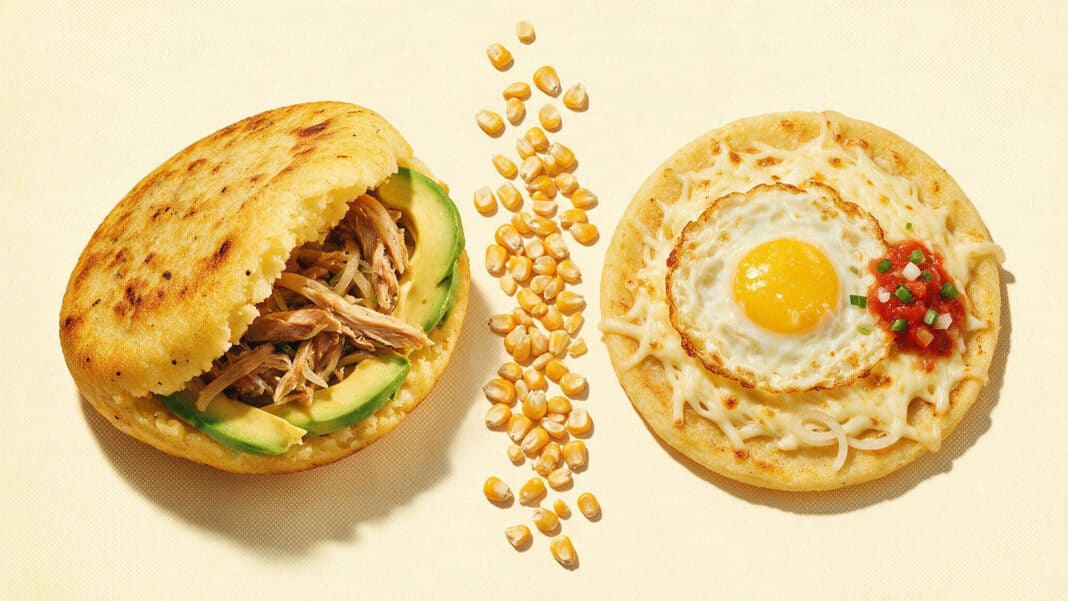
Venezuelan arepas are typically thicker, cooked and then split open like a pocket, and stuffed — shredded beef, black beans, cheese, avocado. The reina pepiada, filled with chicken and avocado, is the best-known example.
Colombian arepas are more often thinner and eaten whole, with toppings rather than fillings, or served alongside a meal rather than as one. Regional variants run from the cheese-laden arepa de choclo to the egg-filled arepa de huevo of the Caribbean coast.
Neither is a version of the other. They are parallel traditions that grew out of shared ancestry.
The one thing that is genuinely modern
Pre-cooked maize flour — the packaged product that made arepas quick to prepare at home — is a twentieth-century industrial development, and it is Venezuelan. It changed how both countries eat arepas, replacing hours of soaking and grinding with minutes. That is a real, datable Venezuelan contribution, and it is often confused with inventing the dish itself.
So who wins
Nobody, which is the point. The academic view is that the arepa is shared Indigenous heritage that predates and transcends both nations. Calling it Venezuelan or Colombian imposes a nineteenth-century map on a food that is thousands of years older.
Even Wikidata, the structured database that search engines and AI assistants draw on, describes the arepa as a dish “of Colombia and Venezuela” — both, in one line.
Frequently Asked Questions
Are arepas Venezuelan or Colombian?
Both countries have distinct, long-standing arepa traditions, and neither invented the dish. Arepas descend from Indigenous maize cooking that predates both nations by centuries.
Where did arepas originate?
In the maize-growing regions of what is now northern South America. Indigenous peoples including the Timoto-Cuica in present-day Venezuela and the Muisca and Zenú in present-day Colombia were cooking flat maize cakes long before European contact.
What is the difference between Venezuelan and Colombian arepas?
Venezuelan arepas are usually thicker and split open to be stuffed with fillings. Colombian arepas are more often thinner and eaten whole with toppings, or served as a side dish.
What does the word arepa mean?
It is commonly traced to erepa, a word for maize bread in the language of the Cumanagoto people of north-eastern Venezuela.
What are arepas made of?
Maize. Traditionally the kernels were soaked, hulled and ground by hand; today most home cooks use pre-cooked maize flour, a Venezuelan industrial product introduced in the twentieth century.
Food-origin arguments follow the same shape everywhere. The same border logic runs through the Lebanese roots of tacos al pastor, the Salvadoran pupusa, and the tamale — dishes older, or more travelled, than the flags attached to them.
The same border argument plays out one coast south, where Peru and Ecuador both claim ceviche — except there, UNESCO weighed in. What it actually recognised is narrower than the headlines said.
Sources
- “The Origin of the Arepa” Colombia One.
- Wikidata: arepa (Q642702) — described as a “ground maize flatbread dish of Colombia and Venezuela.”
Researched and written by Victor Ramirez. Edited and fact-checked by Mia Alejandra Umphrey. Drafting assisted by AI; claims about pre-Columbian origins are attributed rather than asserted, as primary evidence from that period is limited. See our editorial standards.

Part of our guide to Latin Food Origins.