
Cumbia began on Colombia’s Caribbean coast, where African, Indigenous and Spanish traditions collided during the colonial period. It is now the most widely adopted rhythm in Latin America — Mexico, Peru, Argentina and Chile all have their own cumbia — and it is the only one of the region’s four great social dances with no UNESCO listing of its own.
That absence is worth sitting with. Merengue, bachata and Cuban son are all inscribed. Cumbia, which travelled furthest, is recognised by UNESCO only inside something else.
Where it comes from
Cumbia is traced to the Caribbean lowlands of northern Colombia, around the Magdalena River and the town of Santa Cruz de Mompox. Three populations lived in close and coerced contact there from the colonial period on: Indigenous communities, enslaved Africans brought through the transatlantic trade, and Spanish colonisers.
UNESCO’s inscription for the Carnival of Barranquilla describes exactly that convergence on the same coast — “European, African, and indigenous peoples and cultures converged” — and names “the predominant cumbia” among its genres. The carnival was inscribed in 2008. The rhythm at its centre has never been inscribed on its own.
You can hear the three cultures in the instruments
Cumbia’s ensemble is unusually legible. Each part of it came from somewhere specific:
- Tambora — a large two-headed drum of African lineage that anchors the beat.
- Llamador and alegre — hand drums that hold the pulse and drive the dancers.
- Gaitas — long Indigenous flutes, played in male and female pairs, carrying the melody.
- Guache and maracas — shakers that lay the steady texture over the top.
The Los Angeles Philharmonic’s history of the genre points to this drum-and-flute pairing as what makes cumbia recognisable across dozens of national variants. The drums are African, the flutes Indigenous, and the song forms and dress owe most to Spain.
The candle is the whole dance
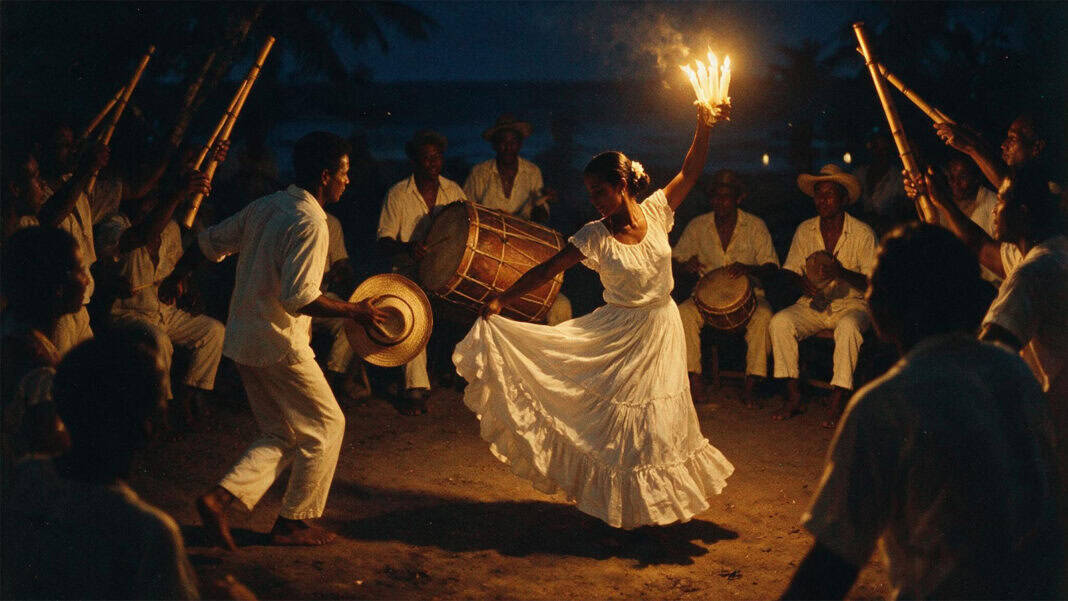
Traditional cumbia is danced in a circle around the musicians. The woman gathers her skirt in one hand and holds a bundle of lit candles in the other, moving with small grounded steps. The man circles her with his hat, pursuing.
The candle is not decoration. She uses the flame to hold him at a distance — courtship as negotiation rather than conquest. That tension between pursuit and poise is the emotional argument of the dance, and it survives intact at Colombian festivals today.
How it became a continent’s rhythm
Cumbia stayed regional for most of its first century. In the twentieth century Colombian orchestras added brass, accordion and studio production, records began to travel, and the genre split into national dialects:
- Mexico — cumbia sonidera, and the keyboard-driven sound of Monterrey.
- Peru — chicha, or cumbia amazónica, fusing it with surf guitar and Andean melody.
- Argentina — cumbia santafesina, and later the urban cumbia villera.
Every version kept the pulse and changed everything else. That is why cumbia functions less like a genre than like a shared language.
Frequently Asked Questions
Where did cumbia originate?
On Colombia’s Caribbean coast, in the lowlands around the Magdalena River and the town of Mompox, from the colonial-era meeting of African, Indigenous and Spanish traditions.
Is cumbia African or Indigenous?
Both. The rhythmic foundation — the drums — comes from enslaved Africans; the melodic gaita flutes are Indigenous to the Caribbean coast. Spanish influence shaped the song forms and the dress.
What instruments are used in traditional cumbia?
Tambora and hand drums for rhythm, paired gaita flutes for melody, and guache and maracas for texture. Orchestral cumbia later added accordion, brass and keyboards.
Why do cumbia dancers hold candles?
The woman uses the lit candles to keep her partner at a distance during the courtship dance — a gesture meaning her affection has to be earned.
How did cumbia spread across Latin America?
Colombian orchestras modernised it in the twentieth century and exported it on record and radio. Mexico, Peru, Argentina and Chile each built distinct national styles on the same core rhythm.
Is cumbia recognised by UNESCO?
Not on its own. It appears inside the 2008 inscription of the Carnival of Barranquilla, which names it as the carnival’s predominant genre. Merengue, bachata and Cuban son each have their own listing.
Cumbia’s spread is the mirror image of salsa, which was assembled in New York from Caribbean parts, and of reggaeton, which travelled from Panama and Jamaica into Puerto Rico. One rhythm left home and adapted; the others were built in the places people arrived.
Sources
- “Carnival of Barranquilla” UNESCO Representative List of the Intangible Cultural Heritage of Humanity, inscribed 2008.
- “A Brief History of Cumbia” Los Angeles Philharmonic.
Researched and written by Victor Ramirez. Edited and fact-checked by Mia Alejandra Umphrey. Drafting assisted by AI; the pre-twentieth-century history of cumbia rests on limited written record, so origin claims here are attributed rather than asserted. See our editorial standards.
Part of our guide to Latin Music History.