
The short version: Corridos tumbados are Mexican corridos, the 150-year-old story-ballad, rebuilt with trap phrasing, requinto guitars, tololoche bass and a brass “charcheta.” The name is tied to Natanael Cano’s 2019 album Corridos Tumbados on Rancho Humilde, a label in Los Angeles. In 2023 Eslabon Armado and Peso Pluma’s “Ella Baila Sola” reached No. 4 on the Billboard Hot 100 and regional mexicano grew 60% in US on-demand audio streams. It’s Mexican-American music, born on this side of the border.
What are corridos tumbados? Five years ago it was a question for people who lived on the Mexican-American internet. Now it’s a genre that packs stadiums, gets banned by Mexican state governments and gets its artists’ visas revoked. So here’s the actual story, because most explainers skip the part where it started in LA.
Start with the corrido
A corrido is a narrative ballad. It tells a story in verses, usually about a real person or event: a bandit, a battle, a flood, a horse race. The form goes back to the 1800s and exploded during the Mexican Revolution. Think of them as the original true-crime podcast.
In the 1970s Los Tigres del Norte, based in San Jose, California, recorded “Contrabando y Traición,” a song about drug smugglers: same form, new subject. The genre has been arguing with the government ever since.
Then it got “tumbado”
Tumbado means knocked down, laid back, lying down. In 2019 a teenager from Hermosillo, Sonora named Natanael Cano released an album called Corridos Tumbados on Rancho Humilde, a label run by Jimmy Humilde out of Los Angeles. The sound: traditional corrido storytelling and sierreño instruments, but with trap cadences, flexed lyrics about money and cars, ad-libs, and a laid-back delivery that sounded closer to Travis Scott than to Vicente Fernández.
The name stuck to the whole movement. Three things define the sound:
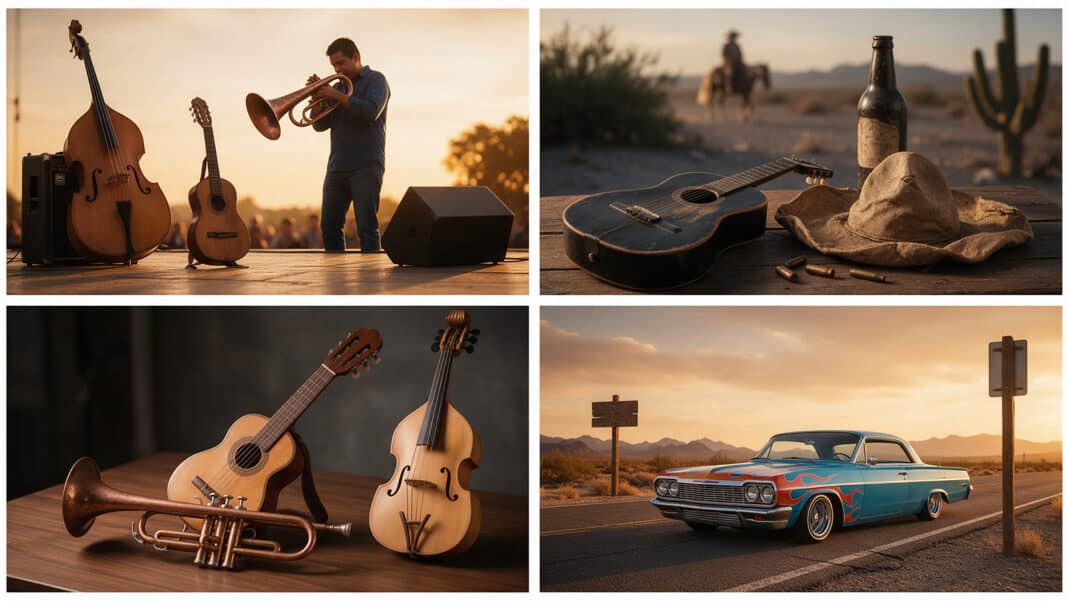
- Requinto and twelve-string guitars doing fast, bright runs. That’s the sierreño DNA.
- The tololoche, an upright bass, giving it the bounce.
- The charcheta, a brass horn line (often a trombone or alto horn) that hits the hook. It’s the sound that makes a corrido tumbado unmistakable within two seconds.
No accordion, mostly. No drum kit. And lyrics that borrow hip-hop’s vocabulary: la clika, los bélicos, el jefe, the Rolex.
2023: the year it broke everything
In spring 2023 Peso Pluma and Eslabon Armado released “Ella Baila Sola.” It reached No. 4 on the Billboard Hot 100, the first regional mexicano song ever to reach that chart’s top 10, and Peso Pluma became YouTube’s most-viewed artist in the US that year. His album Génesis won the Grammy for Best Música Mexicana Album in 2024.
The same year Fuerza Regida, from San Bernardino, California, were selling out arenas. Junior H, Gabito Ballesteros and Ivan Cornejo (the “sad sierreño” lane) have all reached the Billboard Hot 100. Then Xavi, a kid from Phoenix, had “La Diabla” go viral in 2024 and proved the pipeline runs through Arizona too.
Read that list again. Sonora, San Bernardino, Phoenix, an LA label. This is Mexican-American music. It’s the sound of kids who grew up on both corridos and Drake, which is most of the kids in the Southwest.
The bans, the visas and the “bélico” problem
Corridos tumbados inherited the narcocorrido’s fights. A subset called corridos bélicos glorifies cartel figures by name, and it’s the part of the genre that gets headlines.
- Several Mexican states have restricted or banned live performances of narcocorridos, with fines and cancelled shows.
- In 2025 the US revoked the visas of the band Los Alegres del Barranco after they projected an image of a cartel boss at a concert in Jalisco.
Wehpa’s position: the corrido has always documented violence, from the Revolution to the border. Whether a song reports it or advertises it is the real question, and the genre’s best writers know the difference.
Who to listen to right now
If you want the genre beyond the top five names, this is the Wehpa short list. Our Friday drops sweep keeps finding new ones.
- Natanael Cano, the origin.
- Peso Pluma, the crossover.
- Fuerza Regida, the arena act.
- Ivan Cornejo, if you want it sad.
- Xavi, the next generation.
- Carín León, not tumbado but the artist proving regional mexicano can win at the Latin Grammys. Our predictions here.
Why this matters
For most of the 20th century, Mexican-American music was treated as a regional niche by the US industry and as “pocho” by Mexico. Corridos tumbados flipped that. A label in LA and kids from Sonora and San Bernardino built the biggest new genre in the Americas without asking either side for permission. The zoot suiters and lowriders did the same thing with clothes and cars. This is the music version.
Frequently Asked Questions
What are corridos tumbados?
A modern style of Mexican corrido that blends traditional sierreño instruments (requinto, twelve-string guitar, tololoche) with trap-influenced phrasing, lyrics and attitude. The name is tied to Natanael Cano’s 2019 album Corridos Tumbados.
Who started corridos tumbados?
Natanael Cano, with the LA-based label Rancho Humilde and its founder Jimmy Humilde, is credited with popularizing the style in 2019.
What is the difference between corridos tumbados and sierreño?
Sierreño is the guitar-and-bass instrumentation from Mexico’s mountain regions. Corridos tumbados use that setup but add trap cadences, urban slang and often a brass charcheta line.
Why are corridos tumbados banned in parts of Mexico?
Some states restrict narcocorridos and corridos bélicos that glorify cartel figures. Not all corridos tumbados do this, but the genre gets grouped in.
Is Peso Pluma a corridos tumbados artist?
Yes. “Ella Baila Sola” (2023) with Eslabon Armado is the genre’s biggest crossover hit, reaching No. 4 on the Billboard Hot 100.
Watch on Wehpa
Regional mexicano vs reggaeton, lowrider culture history, Chicano slang dictionary. Wehpa TV is free on Roku.