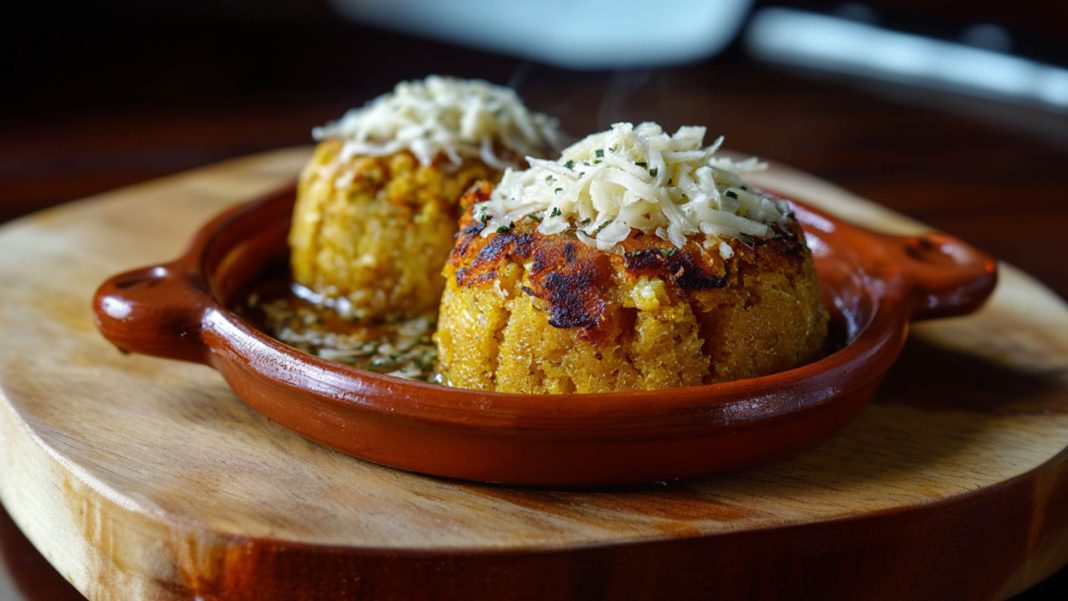


Pupusas are El Salvador’s national dish — thick, handmade corn tortillas stuffed with cheese, beans, or pork, griddled until golden, and served with tangy curtido and salsa roja. Simple, cheap, and deeply satisfying, they’ve gone from Salvadoran street corners to viral food fame around the world. But where did pupusas come from, and how did a humble stuffed tortilla take over global menus? Here’s the full story.
What Is a Pupusa?
A pupusa is a stuffed tortilla — but the trick is that it’s filled before it’s cooked, not after. Soft corn masa (or sometimes rice flour) is packed with a filling, pressed flat by hand, and cooked on a hot griddle called a comal until both sides turn golden and the cheese inside melts. The most common fillings are quesillo (a gooey Salvadoran cheese), refried beans, chicharrón (seasoned ground pork), or loroco, an edible flower bud native to Central America. You eat it with your hands, tearing it open to let the steam escape.
Where Pupusas Come From
Pupusas have their origins in El Salvador, and they go back over a thousand years. According to legend, they were first made by the indigenous Pipil people as a way to feed their warriors during times of conflict. The name itself comes from the Nahuatl word “pipilztli,” meaning “swollen” — a nod to the thick, plump shape of the tortilla. Long before fast food, pupusas were everyday street food: made by hand, sold on corners, and passed down through generations of abuelas.
How Pupusas Are Made
Traditionally, pupusas are made with masa harina, a type of corn flour, mixed with water into a soft dough. A ball of masa is hollowed out, filled, sealed, and patted flat between the palms – a skill that takes practice to pull off without the filling bursting out the sides. Then it goes onto the comal, where it cooks until lightly charred and crisp at the edges. No oven, no fryer just masa, fire, and patience.
Curtido and Salsa Roja: The Perfect Pair
A pupusa is never served alone. It comes with curtido — a lightly fermented cabbage slaw with carrot, onion, and oregano — and a thin, mild salsa roja. The curtido’s tang cuts through the richness of the cheese and pork, while the salsa adds warmth. Spoon them generously over every bite; locals never hold back.

How Pupusas Conquered the United States
In the early 20th century, and especially during the upheavals of the late 1900s, many Salvadorans migrated to the United States in search of safety and opportunity. They brought their love
for pupusas with them, and pupuserías — restaurants specializing in pupusas — began popping up in cities with large Salvadoran communities like Los Angeles and Washington, D.C. El Salvador
loves the dish so much that in 2005 the government officially declared pupusas the national dish and created National Pupusa Day, celebrated on the second Sunday of November. More recently,
social media and food blogs have pushed pupusas into the global spotlight, and people everywhere are discovering their flavors for the first time.
More Than a Dish
Pupusas are more than just a tasty meal. They’re a symbol of El Salvador’s cultural heritage and a reminder of the resilience and strength of the Salvadoran people — proof of the power of food to bring people together and build community. They’ve come a long way from those early Pipil kitchens, and their popularity shows no signs of slowing down. So the next time you get the chance to try one, don’t hesitate. You’ll be tasting a piece of history.
Frequently Asked Questions
What is a pupusa?
A thick handmade tortilla of corn masa, stuffed before it is cooked rather than after, then griddled on a comal until golden. Common fillings are quesillo, refried beans, chicharrón and loroco.
Where do pupusas come from?
El Salvador. They are traced to pre-Columbian maize cooking and generally attributed to the Pipil and Lenca peoples, though the documented record is thin and the origin is attributed rather than proven.
What does the word pupusa mean?
It is not settled. The term is generally traced to Nahuat, the Pipil language, with candidates including pupusawa (“swollen” or “stuffed”), púpu with tsa (“turned over” and “filled”), and putsúua (“stuffing”).
What is curtido?
A lightly fermented cabbage slaw with carrot, onion and oregano, served with every pupusa. Its acidity cuts the richness of the cheese and pork.
Is the pupusa El Salvador’s national dish?
Yes, officially. Legislative Decree 655, published on 1 April 2005, names the pupusa the national dish of El Salvador. National Pupusa Day falls on the second Sunday of November.
What is the difference between a pupusa and an arepa?
Both are maize flatbreads, but a pupusa is stuffed before cooking and eaten flat, while an arepa is usually cooked first and then split open and filled. They come from different traditions — El Salvador and the Venezuela–Colombia region respectively.
Sources
A note on this one. The pupusa’s documented history is thin. El Salvador’s Legislative Decree 655 of 1 April 2005, declaring it the national dish, is a matter of public record. The pre-Columbian origin and the etymology are not — no Tier 1 or Tier 2 source establishes either, so both are attributed here rather than asserted.
An earlier version of this article gave the etymology as a single Nahuatl word, pipilztli, meaning “swollen.” That form does not appear in the sources we could check, and it has been replaced with the range of candidates scholars actually propose.
Researched and written by Victor Ramirez. Edited and fact-checked by Mia Alejandra Umphrey. Drafting assisted by AI; a specific etymology asserted in an earlier draft could not be verified and was replaced with the attributed range; the Wikipedia citation was removed. See our editorial standards.

Part of our guide to Latin Food Origins.