
The piñata’s Mexican roots are solid. Its Chinese roots are a genuine academic argument that is nowhere near settled — and the Marco Polo version you have read a hundred times is the weakest part of it.
That is worth saying plainly, because almost every article on this subject states the Marco Polo story as fact. It is not fact. It is a hypothesis, and the scholar who has argued it most carefully says so himself.
What the Aztecs actually did
This part is not in dispute. To honour the birthday of Huitzilopochtli in mid-December, priests decorated a clay pot with bright feathers, filled it with small treasures, and broke it with a stick so the contents spilled at the feet of the idol as an offering. The Maya had a related practice: striking a hanging pot while blindfolded.
A vessel, a stick, an offering released. The Mesoamerican half of the piñata’s ancestry is documented and specific.
The Chinese claim, stated properly
The usual version goes: the Chinese made seed-filled paper animals for the new year, Marco Polo saw them, carried the idea to Italy, and it reached Spain and then Mexico. Told that way it is a chain of assumptions presented as a chain of events.
There is a real scholarly case underneath it, and it is more specific. In a 2018 paper in the Fudan Journal of the Humanities and Social Sciences, Chen Yong traces the piñata to the Chinese custom of Dachunniu — “hitting the spring ox,” a rite in which a decorated ox figure is struck and broken. That is a far better match than a vague new-year story, and it explains why the folk retelling always mentions oxen.
But read Chen’s own conclusion. The practice “can be tentatively attributed” to Dachunniu, and Marco Polo “might have played a key role in the transmission” — with “any definitive conclusion dependent on additional evidences, textual, or material.” That is a researcher marking the limits of his own case.
Why the Marco Polo link is the weak point
The book attributed to Marco Polo does not mention anything resembling a piñata. That is the problem in one sentence. Some historians go further and question whether Polo reached China at all.
So the honest position is: a specific Chinese rite exists that resembles the piñata; one scholar has argued a connection and called it tentative; and the transmission route everyone names is the part with the least evidence behind it.
What is documented: Acolman, 1586
The Mexican fusion has a date and a place. According to records cited by the Pima County Public Library, the piñata was used for evangelism in 1586 at Acolman, near Mexico City, where Augustinian monks folded it into Las Posadas — deliberately redirecting the existing December Huitzilopochtli celebration toward Christmas.
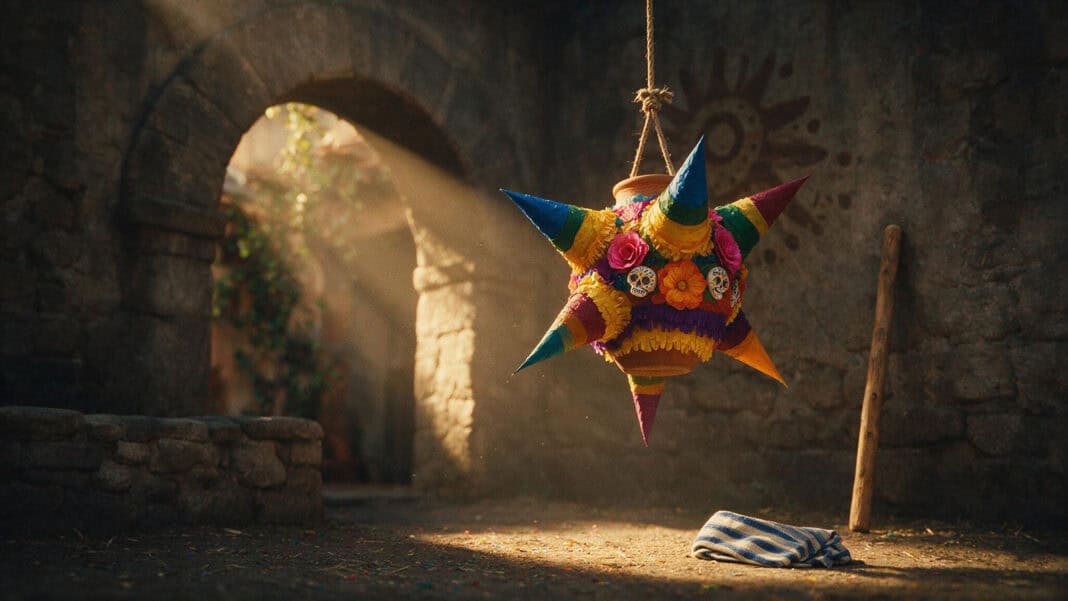
They built a sermon into the object itself:
- The seven points of the star stand for the seven deadly sins.
- The decorated pot is temptation, made attractive on purpose.
- The blindfold is faith, striking without sight.
- The candy falling out is the reward of virtue.
Whether or not a Chinese ox ever entered the story, this is the moment the piñata became Mexican — and it happened because missionaries wanted to replace a god, not because a merchant brought back a souvenir.
Frequently Asked Questions
Where did the piñata originally come from?
The documented ancestry is Mesoamerican: Aztec priests broke a treasure-filled clay pot to honour Huitzilopochtli, and the Maya struck a hanging pot blindfolded. A Chinese origin has been argued academically but is not established.
Did the piñata really come from China via Marco Polo?
This is repeated everywhere but is not proven. The book attributed to Marco Polo contains no mention of anything resembling a piñata. A 2018 paper argues a possible link to the Chinese Dachunniu rite, but its author calls the attribution tentative.
What is Dachunniu?
A Chinese custom meaning “hitting the spring ox,” in which a decorated ox figure is struck and broken. It is the specific tradition scholars point to when they argue a Chinese connection to the piñata.
Did the Aztecs have piñatas?
In a form, yes. They filled a feather-decorated clay pot with treasures and broke it as an offering to Huitzilopochtli. The Maya had a related blindfolded version, so the practice existed in Mesoamerica before the Spanish arrived.
What do the seven points of a piñata mean?
On a traditional star piñata the seven points represent the seven deadly sins, the blindfold represents faith, and the falling sweets represent the reward of virtue.
When did the piñata become a Mexican tradition?
Records point to 1586 at Acolman, near Mexico City, where Augustinian monks used it for evangelism and built it into Las Posadas.
The piñata belongs to a pattern this site keeps running into: a Mexican tradition with a foreign-origin story attached to it that nobody checks. Sometimes the foreign origin is real and documented, as with tacos al pastor. Sometimes it is a claim in search of evidence. See also the tamale, the concha, and what Cinco de Mayo actually commemorates.
Sources
- Chen Yong, “From the Dachunniu to the Piñata: Tracing the Alleged Chinese Origin of a Mexican Tradition” Fudan Journal of the Humanities and Social Sciences, March 2018. DOI 10.1007/s40647-017-0179-6.
- “Piñata – Origin and History” Pima County Public Library.
Researched and written by Victor Ramirez. Edited and fact-checked by Mia Alejandra Umphrey. Drafting assisted by AI; an earlier draft stated the Marco Polo transmission story as established fact. It is not, and the article now says so — the scholar who argues the Chinese link describes his own attribution as tentative. See our editorial standards.