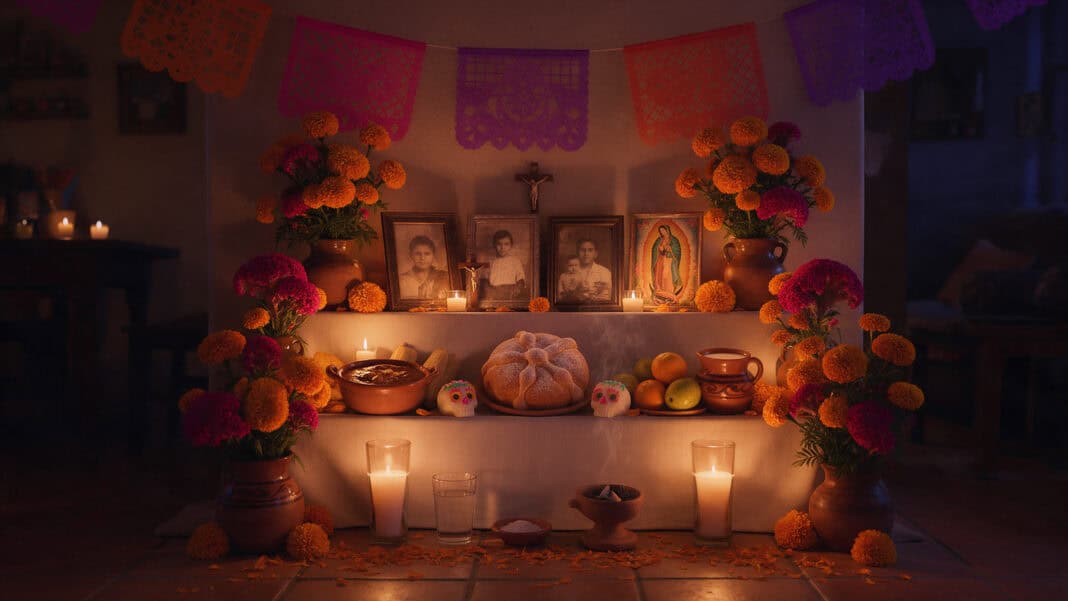

The short version: Halloween comes from the Celtic festival Samhain by way of All Hallows’ Eve and treats the dead as something to ward off. Día de los Muertos comes from Mexica festivals for the dead folded into All Saints’ and All Souls’ Days and treats the dead as guests. Different roots, different dates (October 31 vs November 1–2), different emotion. They only look related because both use skulls and both fall the same week.
Every year around October, someone calls Día de los Muertos “Mexican Halloween,” and every year a Mexican person within earshot ages a full decade. The comparison isn’t offensive so much as backwards. Halloween is about keeping the dead out. Día de los Muertos is about letting them in. Here are the six differences that matter.
1. Different origins on different continents
Halloween descends from Samhain, the Celtic harvest festival in Ireland and Scotland marking the turn to winter, when the boundary between worlds was thin and spirits could cross. Costumes and bonfires were protection. The church later placed All Hallows’ Eve on October 31, the night before All Saints’ Day, and Irish immigrants brought the whole package to the US in the 1800s.
Día de los Muertos descends from Mesoamerica. The Mexica held festivals for the dead in late summer under Mictecacihuatl, the Lady of the Dead. Spanish friars moved those rites onto All Saints’ Day (November 1) and All Souls’ Day (November 2), the same Catholic calendar that gave Halloween its name. So the two holidays share a church calendar, not a culture. One came through Ireland, one through Tenochtitlan.
2. Different dates
Halloween is one night, October 31. Día de los Muertos is November 1 and 2: the first for children who have died (Día de los Angelitos), the second for adults. Some families begin the night of October 31, which is where the confusion starts. But the 31st is the setup. The visit is the 1st and 2nd.
3. Different feelings about the dead
This is the whole thing.
Halloween’s dead are ghosts, zombies, things that chase you. The fun is fear. You dress as something scary to blend in with the scary things, or you dress as something else entirely because it’s a costume party now.
Día de los Muertos’ dead are your grandmother. You build her an ofrenda, cook her mole, light the path with marigolds and wait up. The skulls aren’t frightening. They’re sweet, painted, and often have your living cousin’s name on the forehead as a joke. Death is treated as a relative, not a monster. Octavio Paz wrote that the Mexican “chases after it, mocks it, courts it, hugs it, sleeps with it.”
4. Different objects
Both holidays use skulls, which is where the mix-up starts. But look closer:
| Halloween | Día de los Muertos |
|---|---|
| Jack-o’-lanterns (Irish turnip lanterns, then pumpkins) | Cempasúchil marigolds |
| Costumes to disguise or scare | Face paint as La Catrina, to honor |
| Candy for strangers at the door | Food for the dead on the altar, then for the family |
| Haunted houses | Cemeteries lit with candles all night |
| Plastic skeletons | Sugar skulls and pan de muerto |
5. The parade a James Bond movie invented
Mexico City’s big Día de los Muertos parade, the one you’ve seen with giant floats and thousands of painted Catrinas down Reforma, started in 2016. The year before, the Bond film Spectre opened with a fictional Day of the Dead parade in the capital. Tourists showed up expecting it. So the city built one.
That’s not a scandal. It’s a good parade. But it tells you that the postcard version of the holiday is newer than your abuela, while the real version, in Pátzcuaro, Oaxaca and Mixquic, is candles in a graveyard with no cameras. Coco (2017) did more for global awareness than any government campaign, and it got the emotion right.
6. Whether you can join
Halloween is for everyone by design. Día de los Muertos welcomes people too, with one difference: it asks you to bring someone. Put a real person you lost on your ofrenda, learn what the marigolds and the salt are for, and paint your face as La Catrina knowing who she was. Do that and nobody will side-eye you. Wear a “sugar skull” costume to a Halloween party on the 31st and you’ve combined the two holidays in the exact way this article exists to prevent.
Why this matters
Calling it Mexican Halloween shrinks a 3,000-year-old relationship with death into a costume theme. The point of Día de los Muertos is the opposite of fear: the dead are family, they’re coming over, and you’d better have the food ready. That’s a worldview, not a party. It’s also why the holiday is spreading across the US faster than any other Latino tradition. People want it.
Frequently Asked Questions
Is Día de los Muertos the same as Halloween?
No. Halloween comes from the Celtic festival Samhain and treats the dead as something to fear. Día de los Muertos comes from Mesoamerican and Catholic traditions and welcomes the dead back as guests on November 1 and 2.
When is Día de los Muertos 2026?
Sunday, November 1 (children) and Monday, November 2 (adults). Many families begin preparations on October 31.
Why do both holidays use skulls?
Coincidence of imagery, not origin. Halloween’s skeletons are meant to frighten. Día de los Muertos’ sugar skulls and Catrinas are affectionate and often humorous.
When did the Mexico City Day of the Dead parade start?
In 2016, one year after the James Bond film Spectre showed a fictional parade in the city.
Can non-Mexicans celebrate Día de los Muertos?
Yes, with sincerity: honor a real person, learn what the altar items mean, and keep it separate from Halloween costumes.
Watch on Wehpa
Ofrenda meaning, item by item, La Catrina’s history, Cinco de Mayo is not Independence Day. Wehpa TV is free on Roku.