

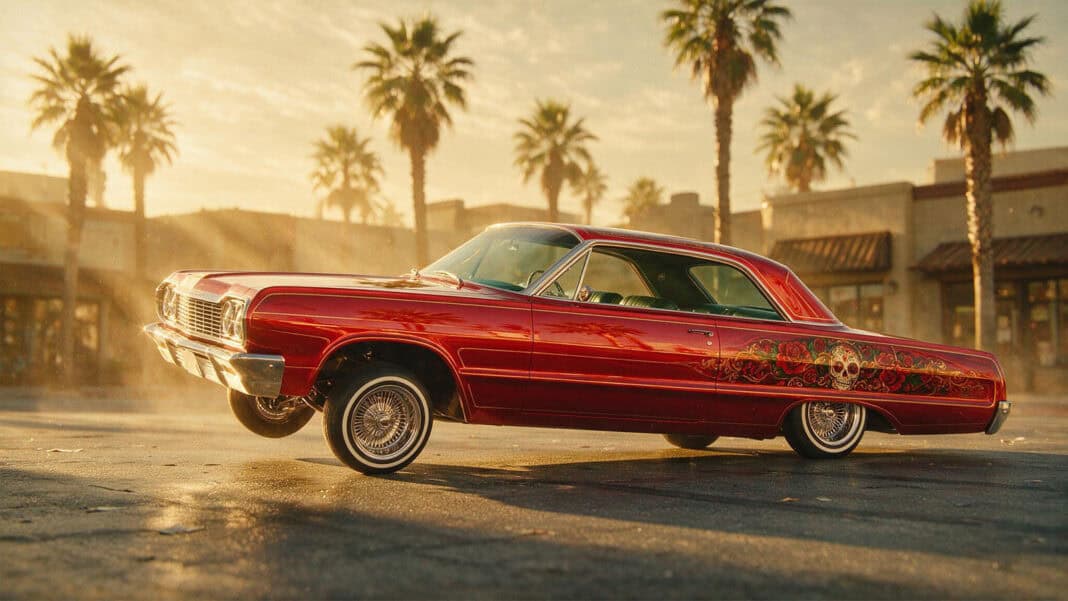
California banned the lowrider stance in 1958. Builders answered with hydraulics, and in 2024 the law that started it all was repealed outright. Sixty-six years from prohibition to repeal, with the culture intact at both ends.
Low and slow, and why
The story starts in the mid-to-late 1940s in the Mexican-American barrios of Los Angeles. Young men returning from the war had mechanical skills, a little money, and a country that kept pushing them to the margins. Hot-rodders modified cars to go faster. Chicano builders did the opposite — dropped the chassis and cruised slowly, so the car and the people in it could be seen.
“Low and slow” was never a speed. It was a claim to public space, and the four-wheeled continuation of what the zoot suit had already done with cloth: take up room, look sharp, do it your own way.
- Murals and pinstriping — family, faith, Aztec imagery, neighbourhood.
- Wire wheels and whitewalls — the signature of the look.
- Car clubs — solo builders became multigenerational communities across the Southwest.
Section 24008
As the cars spread, the law arrived. California Vehicle Code section 24008 made it unlawful to operate a passenger vehicle modified so that any part of it, other than the wheels, sat lower than the bottom of the wheel rims. The classic lowrider stance was, on paper, illegal.
The rule was written in general terms and applied in specific ones. It is widely understood — and was argued explicitly when the legislature came to repeal it — to have fallen hardest on Latino drivers.
The workaround that became the art form
Builders did not stop; they engineered around it. Around 1959 the mechanic Ron Aguirre is credited with fitting aircraft-surplus hydraulics to his car, letting him raise the body to legal height and drop it at the flip of a switch. A law that outlawed a fixed stance could not touch a car that changed its stance on command.
Then the workaround outgrew its purpose. Hydraulics let cars bounce, hop and dance, and hopping became a discipline of its own. The Chevrolet Impala, with its sturdy X-frame, became the platform of choice precisely because it took to the setup. Mechanics turned into artists working in steel, fluid and chrome. NPR’s retrospective traces how the culture carried across generations from there.
Repealed
On 13 October 2023 Governor Gavin Newsom signed Assembly Bill 436, effective 1 January 2024. The bipartisan bill did two things: it removed local authorities’ power to ban cruising under Vehicle Code section 21100, and it repealed section 24008 entirely.
That is the part worth sitting with. The 1958 law that made the lowrider stance illegal is no longer on the books. Cities can still act against genuine nuisance and illegal activity, but the practice itself is not outlawed.
Who it was always for
Cruising is the point. Boulevards like Whittier in East LA became rolling galleries where car clubs, families and onlookers gathered on a Sunday. Lowriding has always been intergenerational — grandparents, parents and kids on the same build — much as Caribbean-American heritage shaped hip-hop as a family-rooted culture rather than a trend.
Women have been central throughout, as builders and as style figures whose look was later repackaged without credit — the subject of our piece on the clean girl aesthetic and its chola roots.
Frequently Asked Questions
Where did lowrider culture start?
In Southern California, especially the Mexican-American barrios of Los Angeles, in the mid-to-late 1940s, as young Chicano builders customised cars to ride low and slow.
What does “low and slow” mean?
Both the look and the intent: the car sits close to the ground and cruises at a relaxed pace, so the focus is style, visibility and community rather than speed.
Why were lowriders banned?
California Vehicle Code section 24008 made it illegal to modify a car so any part of it sat lower than the bottom of its wheel rims, and separate law let cities ban cruising. Both were criticised for targeting Latino drivers.
How did hydraulics get involved?
Around 1959 builders — Ron Aguirre is the name usually credited — fitted aircraft-style hydraulics so a car could sit at legal height and drop on command, defeating the 1958 rule. Hopping and dancing grew out of it.
Is lowrider cruising legal in California now?
Yes. Assembly Bill 436, signed 13 October 2023 and effective 1 January 2024, removed local authority to ban cruising and repealed Vehicle Code section 24008 outright.
Why is the Chevrolet Impala associated with lowriding?
Its X-frame construction suited lowering and hydraulic setups particularly well, which made it a favoured platform among builders.
Lowriding sits alongside the zoot suit and Caló as Chicano culture that was policed before it was celebrated — style treated as a public-order problem.
Sources
- Assembly Bill 436 (2023–2024) California Legislative Information — repeal of Vehicle Code §24008 and cruising-ban authority.
- “Lowrider culture history” NPR, March 2024.
Researched and written by Victor Ramirez. Edited and fact-checked by Mia Alejandra Umphrey. Drafting assisted by AI; the 1958 vehicle-code claim was previously cited to Wikipedia and is now sourced to the California legislature’s own record of the repealing bill. See our editorial standards.

Part of our guide to Latino Style History.